Hedy AI Brings Fully Local Processing to Meetings — Here's What That Actually Means
With Hedy 3.2, the company's entire AI pipeline — summaries, notes, chat, live coaching — can now run on-device with nothing sent to a server. It's opt-in, it's slower than the cloud, and founder Julian Pscheid says that's by design.

Hedy AI Brings Fully Local Processing to Meetings — Here's What That Actually Means
Hedy AI has spent the last two years building a case that the best AI meeting assistant is the one you can trust with your most sensitive conversations. With Hedy 3.2, released in April and detailed further in a May post from founder Julian Pscheid, the company took that argument as far as it can currently go: the entire AI pipeline — transcript summaries, detailed notes, chat replies, and Hedy's real-time coaching suggestions — can now run entirely on the device that captured the audio. No server involved, no conversation data leaving the machine.
That's a meaningfully different claim than most "privacy-first" AI tools make. Plenty of products keep raw audio local while still shipping the transcript off to a cloud model for analysis. Hedy is arguing it doesn't have to work that way anymore — and, per its own writeup, is upfront that the tradeoff isn't free.
What changed, technically
Hedy's speech recognition has always run on-device, and audio has never left the machine. The piece that historically required a server was the actual reasoning: reading a transcript, writing a summary, generating notes, answering questions about a past meeting, and pushing live suggestions mid-conversation. That's model work, and until recently the models capable of doing it well were too large to run on a laptop or phone.
Pscheid's framing, in his own words, is that two trends — device hardware getting more powerful, and open-weight models getting smaller and more capable — crossed a usability threshold this year:
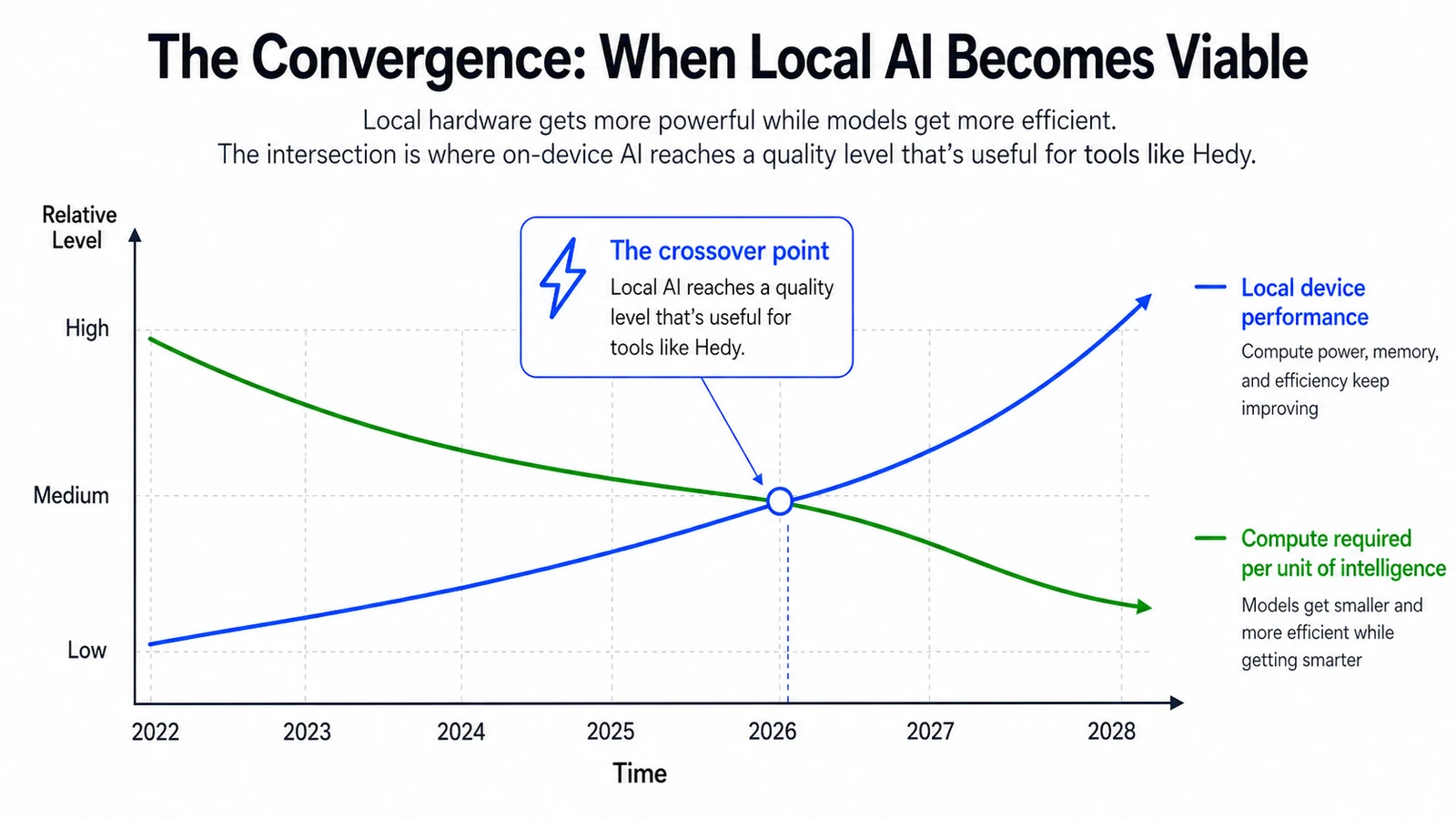 Source: Hedy AI. Illustrative — the chart shows directional trend, not measured benchmarks.
Hedy 3.2 lets users turn on Local AI Processing and pick from three model tiers, from compact (phone-friendly, best for short/simple meetings) up to a top tier that approaches cloud quality on capable hardware. For anyone who wants the technical weeds — which specific models, how they were fit onto Mac, Windows, and iPhone, and what local inference costs in latency — Hedy published a companion engineering deep-dive.
Supported today (per Hedy's Help Center): Apple Silicon Macs, Windows machines with a capable GPU, iPhone 15 Pro and later, and M-series iPads. Android and the web app aren't supported yet — Hedy cites hardware fragmentation on Android and the constraints of running models inside a browser as the blockers.